You open and close your kitchen’s hinges and drawers dozens of times a day. Two kitchens can look identical on the first day and feel completely different after two years, and the difference is almost always the hardware. This guide explains each type and what to ask for.
Hinges: what makes a good one?
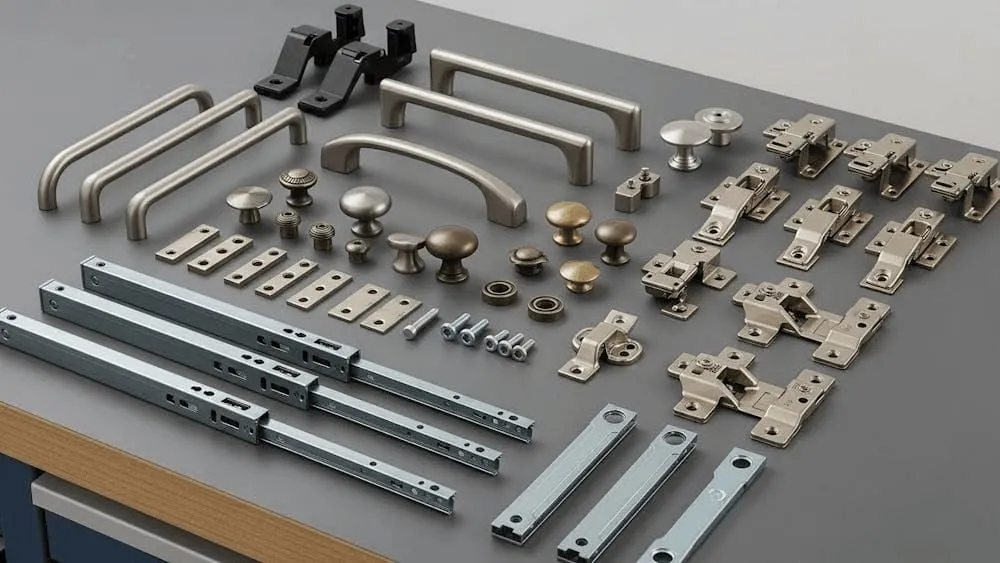
Shutters hang on concealed cup hinges. A good hinge should be:
- Soft-close, so the door closes gently without slamming.
- 3-way adjustable (height, depth and side), so the installer can align doors perfectly and you can re-align them later.
- Clip-on, so a door can be removed for cleaning without unscrewing.
- The right opening angle: about 110° for standard doors, wider-angle hinges for corner units and doors next to walls.
Tall or glass doors need more hinges, so the weight is shared and the door does not drop. For an in-depth comparison of soft-close hinges, push-to-open latches, and touch-assist systems, read our guide on soft-close vs push-to-open vs Servo-Drive hardware.
Drawers: channels or tandem boxes?
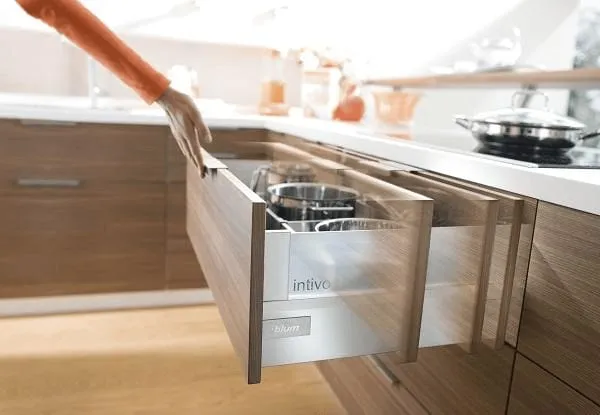
For base units, drawers are far more practical than shutters: you see everything at once and do not have to kneel to reach the back. There are two main systems.
| Telescopic channels | Tandem / box drawer systems | |
|---|---|---|
| How it works | Ball-bearing runners on the drawer sides | Concealed under-mount runners or metal drawer sides |
| Extension | Usually full | Full |
| Soft-close | Optional | Usually standard |
| Load capacity | Moderate | Higher; check the rated load of each model |
| Feel and life | Good when new, can loosen | Smoother and longer-lasting |
| Cost | Lower | Higher |
Indian kitchens store heavy steel and brass utensils, pressure cookers and grain containers, so check the rated load of the drawers that will hold them and use the stronger models there. Learn how soft-close tandem runners compare with push-to-open and motorized drawer systems across high-use cooking zones.
Corner solutions: do not waste the corner
In L- and U-shaped kitchens the corner is the hardest space to reach. Plan it with one of these:
- Carousel: rotating shelves, simple and affordable.
- Swing-out shelf unit: curved shelves that swing out, good for pots and pans.
- Magic corner: linked baskets that slide out in sequence, giving access to the full depth.
- Blind corner with a pull-out: simpler, useful in tight budgets.
Wall units: lift-up fittings
Lift-up (flap) fittings let wall cabinet doors swing upwards and stay open at any height. They are easier to use than side-hinged doors above a hob, and you do not bump your head on an open door. Choose fittings matched to the door’s weight and size.
Tall units and pull-outs
- Pantry pull-outs turn a tall unit into a sliding larder with access from both sides.
- Bottle and spice pull-outs use narrow 150–300 mm gaps next to the hob.
- Wicker or SS baskets are good for onions, potatoes and dry vegetables. For steel baskets, ask for SS 304 grade, which resists rust much better than cheaper grades.
How do you judge hardware quality?
- Ask for the brand and model number of hinges, drawers and lift-ups in the written quote.
- Open and close the display samples: movement should be smooth and silent.
- Check the rated load of the drawers that will hold heavy utensils.
- Ask how long the hardware is covered by warranty and who services it.
- Make sure hardware is screwed into a strong carcass. Our HDHMR vs plywood guide explains why that matters.
Delma kitchens use German-engineered hardware from established European brands such as Hettich and Häfele. You can try the fittings yourself at our Mohali studio, or book a free consultation and we will show you the options in your budget.