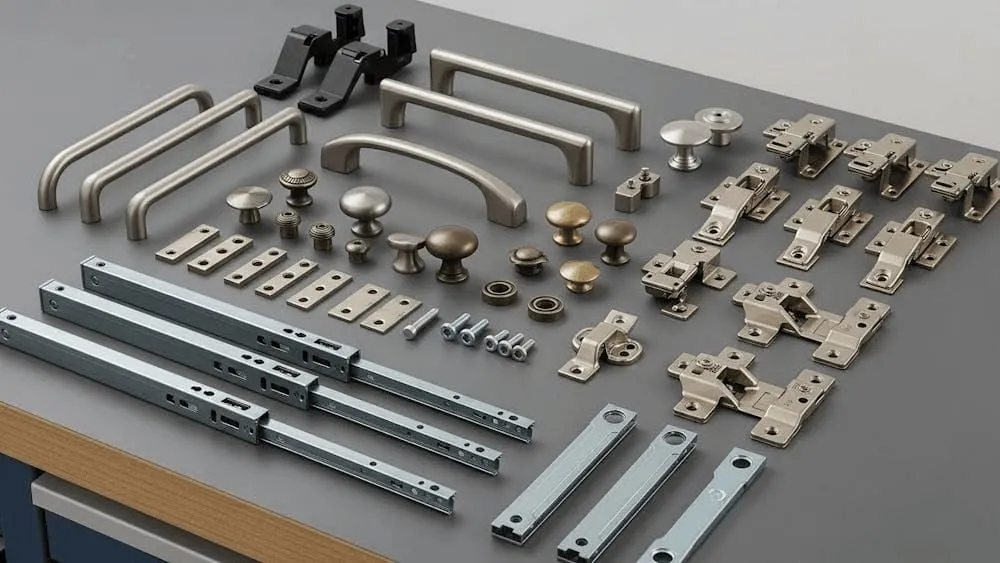
A modular kitchen looks only as refined as its cabinet fronts, but it functions only as well as the moving hardware inside it. In an Indian home, shutters and drawers open and close dozens of times each day under heavy utensil loads and cooking steam.
Three primary motion technologies dominate modern cabinetry: soft-close, push-to-open (mechanical tip-on), and electric assist (such as Blum Servo-Drive). Understanding how these systems work, what they cost relative to each other, and where each belongs helps you allocate your interior budget effectively. For a broader overview of fittings, read our modular kitchen hardware guide.
What is soft-close hardware and how does it work?
Soft-close hardware uses integrated fluid dampers to catch a closing shutter or drawer before it hits the cabinet frame, gently pulling it shut in one continuous, silent movement. The system absorbs physical impact, prevents slamming noise, protects delicate glassware from rattling, and preserves cabinet joints from repetitive stress during daily kitchen work.
At the core of every soft-close fitting is a miniature hydraulic cylinder with silicone fluid. When a shutter or drawer closes, an internal piston enters the fluid chamber during the final two to three inches. This resistance absorbs momentum, and an internal spring glides the front flush against the cabinet box.
Soft-close appears in two main formats:
- Concealed cup hinges for shutters: Standard 35mm cup hinges house fluid dampers directly inside the hinge arm or cup. Quality hinges feature deactivation switches to turn off damping on lightweight doors, preventing unnaturally slow closure.
- Under-mount tandem drawer runners: Mounted beneath the drawer base, tandem runners feature integrated dampers and synchronized tracks. Full extension allows you to pull drawers clear of countertop overhangs to reach items at the back.
Because soft-close is completely mechanical, it requires zero wiring, making it dependable for Indian kitchens exposed to steam, moisture, and spices.
What is push-to-open and when should you choose it?
Push-to-open, often called tip-on, is a mechanical latch system that unlatches and pops a cabinet door or drawer forward by an inch or two when you press anywhere against its front face. It allows you to build completely handleless cabinetry with unbroken, flush architectural surfaces, eliminating handles that can catch clothes in narrow walkways.
When you press the front of a push-to-open cabinet, an internal spring-loaded pin releases and pops the panel outward. From there, you pull the panel open. To close it, you push the front back until the latch clicks and engages.
While push-to-open creates seamless sightlines, consider these practical factors:
- Manual closing required: Standard mechanical tip-on fittings do not soft-close automatically; you must push them shut until the latch engages.
- Combining push-to-open with soft-close: Standard soft-close and basic push-to-open cannot be combined on the same basic fitting because their internal springs pull in opposite directions. Combining push opening with cushioned closing requires specialized hybrid systems (such as Blum Tip-On Blumotion or Hettich Push to Open Silent).
- Surface maintenance on dark finishes: Because hands directly press the panel face, push-to-open fronts collect fingerprints more readily. Pairing them with anti-fingerprint matte PU or textured laminates simplifies daily cleaning.
- Required reveal gaps: Latches require a 2 to 3 millimeter reveal gap between carcass and shutter so the front can travel inward when pressed.
Push-to-open is exceptionally practical for upper cabinets, lofts, and pantry units where handles would interrupt clean architectural lines.
What is Blum Servo-Drive?
Blum Servo-Drive is an electromechanical drive system that opens drawers, waste pull-outs, and overhead lift systems automatically in response to a light tap on the front surface. Powered by a discreet central motor and electrical cabling, it allows deep, heavily loaded drawers to glide open effortlessly, making it available on request for bespoke kitchen configurations.
Rather than relying on stiff spring tension to kick drawers open, Servo-Drive uses small electric drive units mounted on a profile rail at the rear of the cabinet carcass. When a homeowner presses any part of the front with a hand, knee, or hip, a sensitive bumper switch signals the drive unit to nudge the drawer open smoothly. When closing, the drawer relies on built-in mechanical Blumotion dampers to catch the drawer and glide it silently shut.
Servo-Drive is particularly advantageous in three key areas:
- Under-sink waste pull-outs: When preparing food with wet hands, nudging the drawer front with your knee opens the bin without touching any surface.
- Overhead bi-fold lift systems: Reaching high bi-fold wall doors (such as Blum Aventos) can be difficult. Tapping the front opens the door upward, and pressing a wireless switch on the cabinet frame closes it silently.
- Heavy utensil drawers: Deep drawers carrying 30 to 50 kilograms of cookware open effortlessly under electric assist without wrist strain.
Because Servo-Drive requires continuous power through a transformer, cabinets must include planned conduits and an accessible socket. During a power outage, drawers still operate safely by manual hand pulling.
How do soft-close, push-to-open, and Servo-Drive compare?
Each hardware system involves distinct trade-offs regarding ergonomic operation, power dependency, aesthetic appearance, and cost. The comparison table below highlights how these three motion technologies perform across essential kitchen criteria:
| Feature / Criteria | Standard Soft-Close | Mechanical Push-to-Open | Blum Servo-Drive |
|---|---|---|---|
| How it opens | Pull handle, profile, or edge lip | Press front face gently inward | Light touch or tap anywhere on front |
| How it closes | Damper catches and glides shut silently | Push back manually until latch clicks shut | Integrated soft-close glides shut |
| Handles needed? | Yes (handles, Gola channels, J-pulls) | No (flat handleless fronts) | No (works with or without handles) |
| Electrical power? | None (100% mechanical) | None (100% mechanical) | Yes (230V connection and transformer) |
| Best suited for | Cooking drawers, cutlery, base storage | Upper cabinets, lofts, feature walls | Waste bins, bi-fold lift doors, deep drawers |
| Relative cost | Standard / Moderate baseline | Moderate (hybrid units higher) | Premium (motors, cabling, power supply) |
Mixing hardware across zones yields the best balance between ergonomics and budget. To see how hardware selections influence overall cabinetry costs, consult our modular kitchen cost guide for Mohali and Chandigarh.
Which hardware should you choose for each kitchen zone?
Applying the right motion technology to each cabinet zone ensures your kitchen remains intuitive, comfortable, and durable over years of daily cooking:
- Sink base and waste disposal zone: Use mechanical soft-close with Gola channel, or Blum Servo-Drive for the waste pull-out. A knee-activated bin enables hands-free disposal with wet hands. Runners should be fitted on durable BWP plywood.
- Cooking and hob zone drawers: Use heavy-duty soft-close tandem runners. Under-hob drawers carry steel kadhais and spices; soft-close prevents jars from toppling. Choose runners with minimum 30kg to 50kg load ratings.
- Overhead wall cabinets and lift-ups: Use push-to-open latches for side-hung doors, or bi-fold soft-close stay-lift mechanisms that keep doors safely out of head-strike range.
- Tall pantry units: Use 155° or 170° wide-angle soft-close hinges or tandem pull-out frames that allow internal drawers to extend fully without colliding with door edges.
- Corner storage units: Use smooth-pivoting carousel or swing-out tray mechanisms with soft-close return action, bringing stored items forward without banging into cabinet walls.
How do you check hardware quality in a showroom?
When evaluating modular kitchen displays in a studio, test the moving hardware vigorously using these four reliable checks:
- Look for permanent manufacturer stampings: Trusted brands like Blum, Hettich, and Häfele emboss their brand names directly into the metal of the hinge arm and runner rail. Avoid unbranded hardware with loose stickers.
- Test for sideways play under full extension: Pull a wide base drawer all the way out and gently wiggle the front sideways. Quality tandem runners resist racking and wobble, keeping the front square.
- Inspect the closing motion from different angles: Open a shutter halfway, three-quarters, and fully wide, then release. A quality damper takes over smoothly without bouncing back or slamming.
- Verify three-way adjustability: Inspect the hinge body for two or three adjustment screws that allow installers to micro-adjust door height, reveal gap, and depth by millimeters.
How do you maintain kitchen hardware in Indian conditions?
Indian cooking involves high heat, spices, and oil vapors, along with seasonal humidity and dust. Keeping motion hardware functioning smoothly requires sensible care:
- Wipe hinge arms and runner tracks dry: Dust and cooking grease settle on exposed metal over time. Wipe them every few months using a soft dry microfiber cloth. Never spray harsh chemical degreasers directly onto metal hardware.
- Keep runner tracks free of grocery debris: Small grains of rice or spilled flour behind deep drawers can jam guide wheels. Vacuum out drawer tracks periodically to maintain silent gliding.
- Re-tighten and re-align when needed: Heavy utensil weight can cause cabinet doors to settle slightly over time. Use a manual screwdriver to tighten mounting screws or turn the adjustment cam on the hinge arm to level out reveals.
Where can you explore premium kitchen hardware in Mohali?
At Delma Kitchen Craft, every kitchen is manufactured with genuine hardware from Blum, Hettich, and Häfele, matched to moisture-resistant HDHMR and BWP plywood cabinetry. Whether you choose soft-close drawers, push-to-open fronts, or Servo-Drive electric assist, our team helps you select the ideal configuration.
Visit our Mohali studio to test displays, or book a free consultation with our kitchen specialists to plan your modular kitchen layout and obtain an itemized quote.